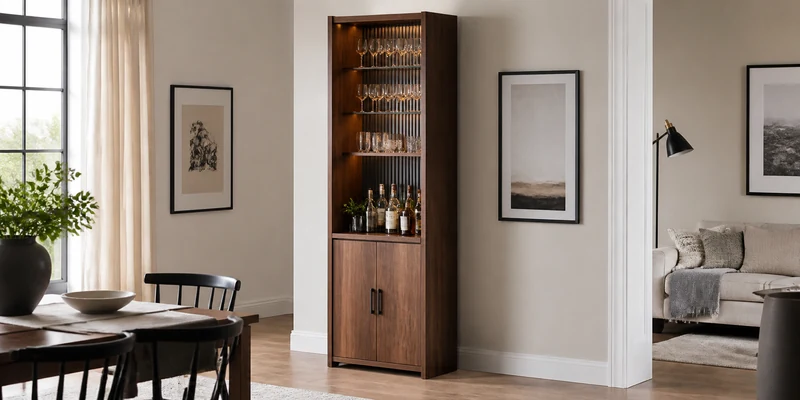
Last updated: August 12, 2026
A tall bar cabinet is the answer to a question most homes eventually ask: where does all of this go? Bottles multiply, glassware collects, and the horizontal surfaces fill up. Going vertical solves it. A tall cabinet stacks display, working storage, and hidden storage on a footprint not much bigger than a dining chair, which is why it has become the default format for a serious home bar in a normal sized room.
The catch is that tall furniture punishes cheap construction. Height amplifies every wobble, thin panels bow under loaded shelves, and a top-heavy cabinet is a tipping hazard rather than a showpiece. This guide covers what to check before buying, which tall cabinet suits which room, and our picks from builds that owners consistently report standing straight and solid.
This article contains affiliate links. If you buy through them, we may earn a commission at no extra cost to you. Learn more.
Quick Answer
What should you look for in a tall bar cabinet?
- Stability first: a wide-enough base, substantial panels, and an included anti-tip wall anchor you actually plan to use.
- Layered storage: display up top, a working shelf or pull-out surface at hand height, closed storage below for the clutter.
- Real interior fittings: bottle racks, stemware rails, and adjustable shelves, not just an empty vertical box.
What to Check Before You Buy
Every row in this table is verifiable from the product listing before you spend anything, and together they filter out most of the disappointing cabinets in the category.
| What to check | Why it matters | What to look for |
|---|---|---|
| Overall height and clearance | Tall cabinets need ceiling room plus tilt-up clearance during assembly | Listed height a few inches under your ceiling; diagonal clearance to stand it upright |
| Base width and depth | A narrow, shallow base makes a loaded cabinet top-heavy | Proportional base, leveling feet, and an included anti-tip kit |
| Panel material | Thin particleboard bows under rows of full bottles | Thick engineered wood or solid wood; shipping weight is an honest clue |
| Shelf setup | Fixed shelves waste vertical space between short and tall bottles | At least one adjustable shelf, stated shelf weight limits |
| Interior fittings | Racks and rails turn raw volume into organized storage | Bottle slots, hanging stemware rails, tool drawer or tray |
| Doors and hardware | Tall doors sag on weak hinges and slam on cheap ones | Metal hinges, magnetic or soft-close catches, handles that feel solid |
| Working surface | Many tall units skip a usable prep area entirely | A mid-height shelf, pull-out board, or counter-height ledge to mix on |
If you are still weighing tall against other formats, our main bar cabinet guide compares every type by situation before drilling into picks.
Why Go Vertical at All?
Storage per square foot is the whole argument, and it is a strong one. A tall cabinet on a two-foot-wide patch of wall can hold what would otherwise sprawl across an entire sideboard plus a shelf. In apartments and modest living rooms, that patch of wall is often the only real estate available, and a tall cabinet uses it without crowding the seating area.
There is also a presentation logic to height. Eye-level shelves, often behind glass, are where the bottles and glassware worth seeing live. The zone at hand height does the work, and the bottom section swallows bulk and backups. That vertical hierarchy is exactly how a well-run bar organizes itself, and our guide on how to organize a bar cabinet turns it into a repeatable system.
Where a tall cabinet is the wrong call
Skip the tall format if your walls are short, your floors are noticeably uneven, or you need a large mixing surface more than you need storage. Sideboard-height cabinets and hutch-style pieces trade capacity for counter space, and in a room with a low or sloped ceiling they simply fit better. Households with climbing-age kids should either anchor a tall unit firmly or consider a locking bar cabinet instead.
Our Top Picks at a Glance
How we chose: we compared widely available tall bar cabinets on stability, panel thickness, interior fittings, assembly experience, and how consistently owners report them staying square and rattle-free once loaded. Selections lean on manufacturer specifications and recurring themes in customer reviews rather than any hands-on trial of our own.
A practical note first: tall cabinets are a two-person job at the tilt-up stage, and nearly every negative assembly review in this category traces back to rushing that step alone.
🏆 Best Overall
An industrial-style tall cabinet that layers a bottle rack, hanging stemware rails, open display shelving, and a closed lower cabinet on a narrow footprint, with a wine rack and glass holders that keep the height useful.

💛 Best Value
A rustic-industrial tall unit that keeps the essential fittings, glass holders, display shelving, and a usable mid section, at a price that makes it an easy first serious bar cabinet.

✨ Best for Display
A glass-door tall cabinet with built-in lighting and full-height visibility, for collections that deserve to be seen while staying dust-free behind doors.

Picks for Specific Setups
Beyond the top three, two formats solve narrower problems: furniture-first rooms and cabinets that need to keep bottles secured.
🎯 Best Furniture-First
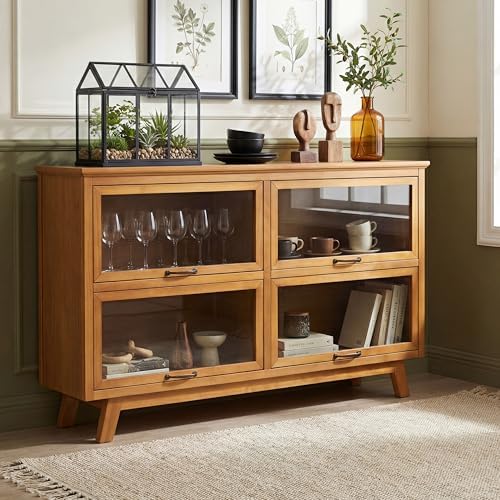
A cabinet in warm natural wood tones with glass display and wood doors that read as living-room furniture rather than utility storage. For rooms where the bar has to match the rest of the interior.
🔒 Also Great: Lockable
A tall cabinet with locking glass doors over the full bottle section, keeping the vertical storage advantage while adding a layer of control for households with kids or shared spaces.

Assembly, Anchoring, and Loading
Assemble flat-pack tall cabinets near their final spot, because a fully built unit is awkward to move and doorways become puzzles. Run all bolts in loosely, square the frame against a wall, then tighten in stages so nothing racks. Level the feet before loading anything; a cabinet that rocks empty will creak forever loaded.
Then anchor it. Nearly every tall cabinet ships with an anti-tip strap or bracket, and the few minutes it takes to fix it to a stud is the difference between furniture and hazard. Load heavy items low and light items high: bulk bottles and backups in the bottom cabinet, everyday bottles at hand height, glassware and display pieces up top. Keep wine out of the warm upper zone if your room runs hot; our wine storage temperature guide explains why heat is the enemy of anything you plan to keep a while.
Common Mistakes to Avoid
- Forgetting tilt-up clearance. A cabinet assembled flat on the floor needs diagonal room to stand up. Measure the diagonal, not just the height.
- Skipping the wall anchor. Top-heavy plus unanchored is how tall furniture ends up in incident reports. Use the included kit.
- Loading heavy bottles on top. High weight raises the tipping point and stresses the upper shelves. Heavy goes low.
- Buying an empty vertical box. Without racks and rails, half the volume becomes dead air between bottle tops and the next shelf.
- Ignoring floor levelness. Old floors lean. Cabinets with adjustable feet handle it; cabinets without them rock permanently.
- Placing it beside a radiator or sunny window. Heat and light fade finishes and warm the contents, which matters most for wine.
Where to Go From Here
If your wall cannot take a full-height unit, the compact formats in our small bar cabinet guide keep the same layered logic at half the height, and an unused corner can host a surprising amount of storage with the right corner bar cabinet. Planning to chill wine as part of the setup? Cabinets with a dedicated fridge bay are their own category, covered in our bar cabinet with wine fridge space roundup.
Frequently Asked Questions
How tall is a tall bar cabinet? There is no fixed standard, but the format generally means clearly taller than sideboard height, often eye level or above. Always check the listed height against your ceiling and remember tilt-up clearance during assembly.
Do tall bar cabinets tip over easily? A quality cabinet, loaded heavy-low and anchored with its included anti-tip kit, is stable in normal use. Unanchored, top-loaded, or on uneven floors, any tall furniture becomes a risk. Anchoring is the fix.
Can a tall bar cabinet hold a full glassware collection? Usually yes, and better than most formats, thanks to hanging stemware rails and adjustable shelves. Check the stated shelf weight limits and keep the heaviest glass at or below hand height.
Are tall bar cabinets hard to assemble? They take longer than small units, typically a calm afternoon, and the tilt-up stage needs two people. Owners consistently report that careful staged tightening is what separates solid results from wobbly ones.
Is a tall cabinet better than a bar cart? For storage capacity and a permanent setup, clearly yes. For mobility and small budgets, a cart wins. Our bar cabinet vs bar cart comparison covers the decision in full.
The Bottom Line
A tall bar cabinet is the most storage-efficient way to build a home bar on a narrow patch of wall, provided you buy for stability and fittings rather than photos. Look for substantial panels, adjustable shelves, bottle and stemware racks, and an anti-tip kit, then load it heavy-low and anchor it. Done right, it organizes an entire bar into two square feet.