Last updated: August 12, 2026
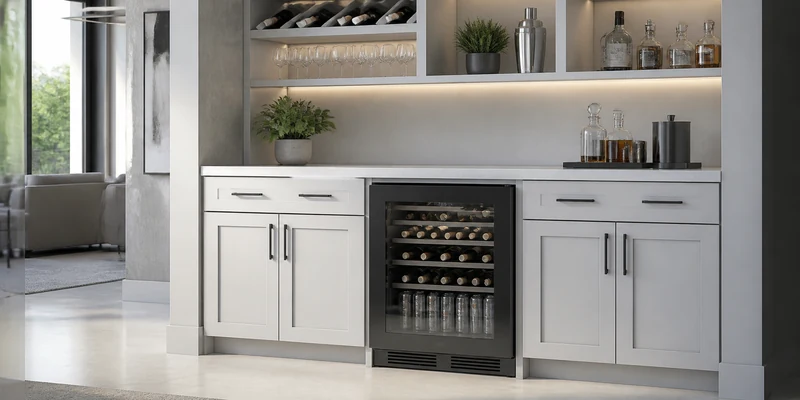
A bar cabinet with fridge space solves the last problem of a good home bar: cold storage that does not live in the kitchen. Instead of trekking to the refrigerator for every chilled bottle, you slide a compact wine or beverage fridge into a purpose-built bay in the cabinet itself, and the whole bar, bottles, glasses, tools, and chill, lives in one piece of furniture.
The format has boomed alongside coffee bar cabinets, and many of the best options are actually sold for either use. But putting a heat-producing appliance inside furniture is not plug-and-play: ventilation, clearances, and fridge type decide whether the setup hums along quietly or cooks itself. This guide covers how to match cabinet and fridge safely, what to check in listings, and our picks among cabinets with genuinely usable appliance bays.
This article contains affiliate links. If you buy through them, we may earn a commission at no extra cost to you. Learn more.
Quick Answer
What should you look for in a bar cabinet with fridge space?
- An open bay with real clearance: the compartment must exceed the fridge’s dimensions on all sides, with an open back or vent cutouts for airflow.
- The right fridge type: front-venting units are made for enclosed bays; rear-venting freestanding fridges need generous open space around them.
- Cable routing and a nearby outlet: a cord hole in the cabinet back and an outlet you will not have to extension-cord across a walkway.
What to Check Before You Buy
Match the cabinet to the fridge, or better, choose them together. Every row here comes straight from the two listings side by side.
| What to check | Why it matters | What to look for |
|---|---|---|
| Bay interior dimensions | Fridges need clearance beyond their listed size to breathe and to slide in | Bay noticeably larger than the fridge on width, height, and depth; makers often state a max fridge size |
| Ventilation path | Compressors dump heat; trapped heat forces the fridge to run constantly | Open back, vent cutouts, or slatted panels behind the bay |
| Fridge venting style | Front-venting units tolerate enclosure; rear-venting units do not | “Built-in capable” or front-venting fridges for tight bays |
| Floor of the bay | A loaded fridge concentrates weight on a small footprint | A reinforced or bottom-level bay, not a mid-height particleboard shelf |
| Cord management | A visible cord across the cabinet ruins the built-in effect | A back cutout or grommet hole aligned with the bay |
| Counter and storage layout | The fridge is one zone of a working bar, not the whole point | Bottle rack, stemware storage, and a usable top alongside the bay |
Choosing the fridge itself is its own decision; our guide to the best wine fridge covers sizes and cooling types, and the dedicated wine fridge for cabinet roundup focuses on units suited to enclosed bays.
Ventilation: The Part That Actually Matters
Every fridge moves heat from inside the box to outside it, and that heat has to go somewhere. Freestanding wine fridges typically vent at the back and rely on open air around the unit; boxed into a snug cabinet bay, they recirculate their own hot exhaust, run continuously, and age fast. Front-venting units, often sold as built-in capable, exhaust under the door at the front and are designed to sit flush inside cabinetry.
The practical rule: for a snug, built-in look, buy a front-venting fridge; for a generous open bay with an open back, a freestanding unit can work if you respect the maker’s stated clearances on all sides. When in doubt, more air is always safe and less never is. An under counter wine fridge is the classic front-venting format and pairs naturally with counter-height cabinets.
Compressor heat and your bottles
There is a storage angle too: a fridge working overtime in a hot enclosure cycles temperature more than it should, and stable temperature is the point of chilled bottle storage in the first place. Our wine storage temperature guide explains why stability beats any single number, which is exactly what good ventilation protects.
Our Top Picks at a Glance
How we chose: we compared cabinets with appliance bays on bay dimensions and ventilation, structural quality around the opening, storage layout, and how consistently owners report fitting real fridges without heat or fit problems. Selections lean on manufacturer specifications and recurring review themes rather than any hands-on trial of our own.
Note that this category overlaps heavily with coffee bar cabinets, and that is fine: a well-ventilated bay does not care whether it holds a wine fridge or a mini fridge, and many owners run these cabinets as dual coffee-and-bar stations.
🏆 Best Overall
A hutch-style bar cabinet with a dedicated open fridge bay, power outlet, and storage above and beside it, designed from the start to host a compact fridge rather than adapted to one.

💛 Best Value
A simpler buffet-style cabinet with an open fridge bay and a wine rack that accommodates a small fridge at an entry price, with enough top surface to work as a serving station.

📏 Best Full-Height Station
A tall unit combining a fridge bay, closed storage, and display shelving into one wall-anchored bar station, for households consolidating the entire setup into a single footprint.

Alternative Routes to the Same Result
If no all-in-one cabinet fits your space, two modular routes work just as well.
🔀 Best Modular Pairing
A standard bar cabinet placed beside a freestanding compact wine fridge of matching height, reading as one built unit while giving the fridge unrestricted airflow.

🧱 Also Great: Countertop Route
A sturdy counter-height cabinet with a small countertop wine fridge on top, the lowest-commitment version that keeps every ventilation question trivially solved.

Installation and Everyday Use
Set the cabinet in its final position before installing the fridge, level the feet, and route the cord through the back cutout to a nearby outlet, avoiding extension cords where the maker advises against them. Slide the fridge in on a protective mat if the bay floor is finished board, confirm the door opens fully without hitting the cabinet frame, and leave the stated clearance on every side, especially behind.
Afterward, listen. A correctly ventilated fridge cycles on and off; one that runs continuously in an enclosure is telling you it cannot shed heat. Dust the vents a few times a year, keep the bay free of stored clutter that blocks airflow, and the pairing will run for years. For what goes where in the rest of the cabinet, our how to organize a bar cabinet guide covers the zones.
Common Mistakes to Avoid
- Boxing a rear-venting fridge into a snug bay. It will run hot and constantly. Snug bays need front-venting, built-in capable units.
- Measuring the fridge, not the clearances. The fridge’s listed size plus required clearance is the real number to compare against the bay.
- Putting the fridge on a weak mid shelf. A loaded fridge belongs at the reinforced bottom of the cabinet, not on a sagging shelf.
- Ignoring the door swing. Fridge doors need clearance to open past ninety degrees so shelves slide out. Check hinge side against the bay position.
- Draping the cord across the cabinet face. Plan the outlet and cutout route before assembly, not after.
- Placing the whole unit in sun or beside a radiator. External heat makes the fridge work harder and destabilizes the very temperatures you bought it for.
Where to Go From Here
Choosing the fridge half of the equation is the bigger research job: start with the best wine fridge overview, or go straight to wine fridge for cabinet if the bay is already decided. For the furniture half, the main bar cabinet guide covers every format if you decide the fridge should live elsewhere after all.
Frequently Asked Questions
Can you put any wine fridge inside a bar cabinet? No. Snug enclosed bays need front-venting, built-in capable units. Rear-venting freestanding fridges only belong in bays with an open back and generous clearance on all sides per the maker’s specs.
How much clearance does a fridge need in a cabinet bay? Follow the specific manufacturer’s stated clearances, which vary by model and venting design. As a principle, front-venting units tolerate tight fits; everything else wants open space, especially behind.
Do cabinets come with fridges included? Usually not. Most are sold as cabinets with a fridge-ready bay, and you choose the fridge separately, which is better anyway since it lets you match capacity and venting style to your needs.
Is a thermoelectric or compressor fridge better inside furniture? Compressor units cool more strongly and handle warm rooms better; thermoelectric units are quieter but sensitive to ambient heat, which makes ventilation even more critical in an enclosure. Match the type to the bay and the room.
Will the fridge be loud in a living room cabinet? Modern compact fridges are generally living-room friendly, and a cabinet can even soften the sound. A unit that is audibly running all the time signals a ventilation problem, not a noisy model.
The Bottom Line
A bar cabinet with fridge space works when the bay and the fridge are chosen as a pair: real clearance, a ventilation path, a reinforced floor, and a venting style that matches the enclosure. Get the airflow right and everything else is furniture shopping. The result is the most complete single-piece home bar you can build.