Last updated: August 12, 2026
Learning how to organize a bar cabinet is the difference between owning a bar and owning a cupboard of bottles. The furniture can be perfect, but if finding the right glass takes archaeology and the good bottle hides behind three novelty mixers, the cabinet stops being used, and an unused bar is just expensive storage. The fix is not more space; it is a system.
The good news: organizing a bar cabinet properly is a one-afternoon project that holds for months, because the method below builds the maintenance into the layout. It works for every format, tall unit, sideboard, corner cabinet, or compact two-door, and needs nothing more than what you already own plus maybe a tray or two.
Quick Answer
How do you organize a bar cabinet?
- Empty it completely, then sort everything into keep, relocate, and let go before anything returns.
- Zone by frequency: everyday bottles and tools at grab height, display up top, bulk and backups below.
- Give tools one tray, glasses one home each, and finish with a five-minute reset after every hosting evening.
The Step-by-Step System
Work the steps in order; each one sets up the next. Save this plan for the afternoon you block out.
- Empty everything and clean the cabinet. Every bottle, glass, and gadget comes out onto a table. Wipe shelves, check for rings and sticky spots, and take the one honest look at your collection you never get while it is stacked.
- Sort into keep, relocate, and let go. Keep what you actually use or genuinely save for occasions. Relocate what belongs elsewhere: paper napkin hoards, the fondue set, the shaker’s original box. Let go of the sticky decade-old bottles with an inch left and the freebie glasses you never liked.
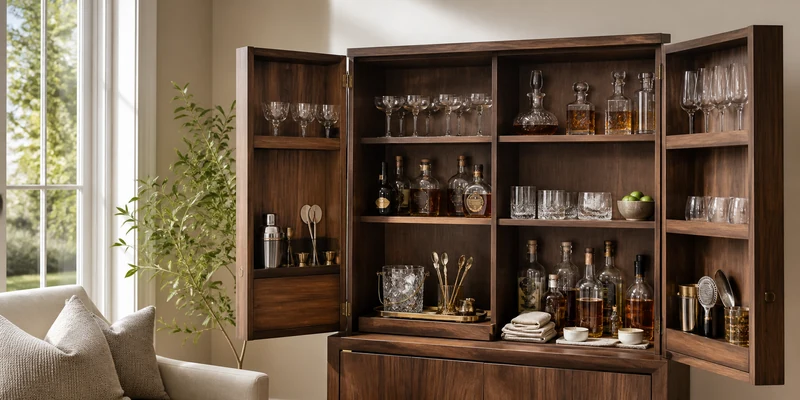
- Define your zones by frequency of use. Grab height, roughly chest level, is prime real estate for the bottles and tools of a normal week. Eye level and above is display: the bottles and glassware worth seeing. Below the waist is bulk: backups, mixers, seldom-used equipment.
- Give every glass type one home. One shelf or rail per glass family you actually use. Hang stems on rails or rack them upside down to stay dust-free; retire orphan glasses to the relocate box without guilt.
- Corral the tools on a single tray. Shaker, jigger, strainer, spoon, opener, on one tray or in one drawer, always. The tray lifts out when you mix and returns as a unit, which is the whole maintenance trick.
- Place bottles by type, tallest at the back. Group families together so restocking is a glance, not an inventory. Wine stored for more than a few weeks lies horizontal in a rack, away from the warmest part of the cabinet.
- Stage the top as a working surface. Clear by default: a tray with the current favorites, maybe a decanter or a plant, and open counter for actual mixing. The top is a workspace, not overflow storage.
- Build the five-minute reset. After each hosting evening: glasses to the wash, tools wiped and back on their tray, bottles to their zones, top cleared. Five minutes while the kettle boils keeps the system alive indefinitely.
The Zone Logic, Explained
Frequency-based zoning works because it matches the cabinet to how hosting actually flows. During an evening you reach for the same half-dozen things repeatedly, everyday bottles, the tool tray, the working glasses, so those live where a reach costs nothing. Display items are retrieved rarely but seen constantly, which is why they earn the sightline shelves. Bulk is retrieved rarely and seen never, hence the bottom.
The same logic scales to any cabinet size. In a compact two-door unit the zones become shelf-halves rather than whole shelves; in a tall unit they stretch across five levels. If your current furniture fights the system, no rail for stems, shelves that will not adjust, that is a furniture problem rather than an organizing one, and our guide to the best bar cabinet shows what to look for in a cabinet that cooperates.
Small Upgrades That Punch Above Their Price
A handful of cheap helpers multiply usable space. Shelf risers double stacking height for short bottles and let glasses live above them. Under-shelf stemware rails reclaim the dead air below a shelf. Turntables tame deep corners where bottles otherwise vanish. Drawer organizers or a simple bamboo tray keep tools from drifting, and a marker-and-tag system on bulk bins downstairs ends the mystery-box era.
Lighting deserves a mention: a battery puck light or an LED strip inside makes the cabinet usable in evening light, which is when you actually use it. Warm white flatters wood and bottles alike, and adhesive mounting keeps it renter-friendly.
What Belongs Elsewhere
Part of organizing the cabinet is deciding what it should not hold. Perishables, citrus, juices, anything opened that needs cold, live in the kitchen refrigerator, not the cabinet. Bottles you intend to keep for years deserve better conditions than room-temperature furniture; our wine storage temperature guide explains the commonly recommended ranges and why stability matters more than any single number.
The cabinet also should not hold aspirations. A bottle bought for a cocktail you made once in 2019 is occupying prime shelf space rent-free. Keep the working collection honest and the cabinet stays organized almost by itself; for a sensible baseline of what a working setup actually needs, our home bar essentials checklist is the reference.
Common Mistakes to Avoid
- Organizing without emptying first. Shuffling in place preserves the problem. The table-sort is where the transformation happens.
- Zoning by looks instead of frequency. A photogenic arrangement that puts your daily bottle behind the decanter dies in a week.
- Letting tools scatter. The jigger in the kitchen drawer is how bar cabinets decay. One tray, always.
- Storing stemware upright on open shelves. Dust settles straight into the bowls. Rails or upside-down racking.
- Using the top as a landing strip. Mail and keys colonize any flat surface allowed to receive them. The top has one job.
- Skipping the reset ritual. Organization is not an event, it is the five minutes after each evening. Build it in or repeat the whole afternoon quarterly.
Frequently Asked Questions
How should bottles be arranged in a bar cabinet? Grouped by type, tallest at the back, with the everyday rotation at grab height and rarely used bottles higher or lower. The arrangement should answer “do I have X?” at a glance.
Should wine be stored in a bar cabinet? Short-term, yes, horizontal in a rack away from heat and light. For months-to-years keeping, room-temperature furniture is not ideal; see our wine storage temperature guide for what actually matters.
How do I organize a small bar cabinet? The same system with stricter editing: a working set only, shelf risers and under-shelf rails to reclaim vertical space, and backups stored elsewhere. The zones become shelf-halves instead of whole shelves.
What tools should live in the cabinet? One tray with shaker, jigger, strainer, bar spoon, and opener covers most evenings. Everything else is occasional and can live in the bulk zone until proven otherwise.
How often should I reorganize? With the five-minute reset after each hosting evening, a full redo is rarely needed more than once or twice a year, typically when the collection has genuinely changed shape.
The Bottom Line
Organizing a bar cabinet is one honest empty-and-sort, a frequency-based zone layout, one tray for tools, and a five-minute reset that keeps it all standing. The system fits any cabinet format and survives real hosting because maintenance is built into the layout. Block an afternoon, work the steps in order, and the cabinet starts earning its place.