Last updated: August 12, 2026
A small wine fridge is the honest answer for most homes. Not everyone is cellaring cases; plenty of us just want a dozen or two bottles held at the right temperature in an apartment kitchen, a bar corner, or under a console table. The compact class, roughly 6 to 24 bottles, does exactly that without surrendering a wall of floor space.
The catch is that the small end of the market is where the weakest cooling hardware hides. This guide explains how to tell a genuinely capable compact unit from a glorified mini fridge, and which small models owners keep recommending after the first summer, the season that exposes the pretenders.
This article contains affiliate links. If you buy through them, we may earn a commission at no extra cost to you. Learn more.
Quick Answer
Which small wine fridge should you buy?
- A compressor-cooled unit in the 12 to 24 bottle range is the sweet spot: apartment-friendly footprint, real cooling power, and room for a modest rotation.
- Thermoelectric models are only a fit for cool, climate-controlled rooms. In a warm kitchen they run constantly and still fall short of their setting.
- Check the real dimensions and door swing against your spot before the bottle count; compact units vary more in shape than in capacity.
What to Check Before You Buy
Small fridges get parked in tighter, warmer corners than their full-size siblings, which makes the checklist below stricter, not looser.
| What to check | Why it matters | What to look for |
|---|---|---|
| Cooling type | Compact cases hide weak hardware | Compressor cooling unless the room stays cool year round; thermoelectric only for quiet, temperate spaces |
| Real capacity | Ratings assume slim Bordeaux bottles | Subtract a few bottles from the rating for a mixed collection; wide bottles and Champagne eat shelf space |
| Footprint and clearance | Small units end up in tight corners | Width, depth with the door, and the vent clearance the manual asks for, usually a few inches around freestanding units |
| Noise | Compact fridges live close to people | Owner feedback on hum in quiet rooms; thermoelectric wins here if the room allows it |
| Door glass | Light is a known enemy of stored wine | Tinted or UV-resistant glass, especially near windows |
| Shelving | Cheap wire shelves waste scarce space | Sliding shelves and a layout that accepts a few larger bottles without losing a whole row |
Unsure whether even a compact unit is justified for your drinking rhythm? Our plain-spoken look at whether you need a wine fridge settles it in five minutes.
Compressor vs Thermoelectric at Small Sizes
The cooling question bites hardest in this class, because thermoelectric technology is cheapest to build small, so the compact shelf at any retailer is full of it. Thermoelectric coolers are genuinely silent and vibration-free, which is kind to wine, but they can only pull a limited number of degrees below the surrounding room. In a kitchen that hits the 80s Fahrenheit in July, a thermoelectric unit set to 55 simply never gets there.
Compressor-cooled compacts cost a little more and hum a little, but they reach and hold their setting regardless of a warm room. The practical rule: thermoelectric for a cool basement office or a temperate dining room where silence matters; compressor for kitchens, bar corners, and anywhere the thermostat swings. If your bottles are shorter-term drinkers, the stakes are lower; for keeping anything worth aging, stability wins, as our wine storage temperature guide explains.
Our Top Small Wine Fridge Picks
How we chose: we compared compact models on cooling type, temperature stability in warm rooms, noise, shelving, and how consistently owners still recommend the unit after a year. We work from manufacturer specifications and recurring owner feedback rather than hands-on trials of our own.
One note on expectations: at this size, one good zone beats two cramped ones. Dual zone returns at larger capacities, covered in our dual zone guide.
🏆 Best Overall
A compressor-cooled compact in the 12 to 18 bottle class with a stainless-trimmed glass door and steady cooling that owners confirm holds up in real kitchens. The default small fridge for most homes, from the brand covered in our NewAir review.

💛 Best Value
A budget-friendly compact cooler for cool rooms and light duty, quiet by nature and honest about its limits. The right pick when the room is temperate and the collection is a rotating dozen.
⭐ Upgrade Pick
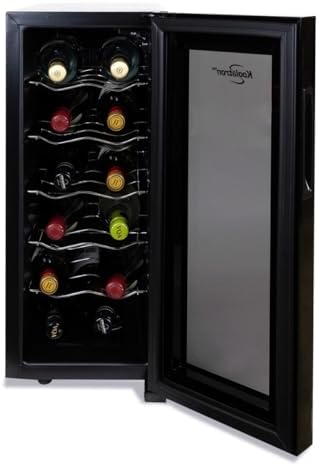
A 29 bottle compact unit with wood-trimmed sliding shelves and build quality a step above the compact norm, for the buyer who wants small outside and serious inside.

Where a Small Fridge Fits Best
The compact class shines in three spots. In apartment kitchens it stands at the end of a counter run or replaces a cabinet’s worth of floor space. In living rooms it tucks beside or under console furniture, keeping serving wine where guests actually are; pair it visually with the setups in our bar cabinet with fridge space guide. And on sturdy counters, the smallest units work as true countertop appliances, a subcategory with its own rules covered in the countertop wine fridge roundup.
Wherever it lands, respect the venting. Freestanding compacts exhaust from the back and need those few inches of breathing room; only front-venting models can be boxed in flush, the same rule that governs the under counter class.
🧊 Best for Countertops
A slim, light unit sized for a counter or sideboard top, ideal for keeping the week’s whites at serving temperature next to the glasses.

👍 Also Great
A compact compressor alternative with a clean modern front, frequently mentioned by owners as a quiet and reliable pick in the same class as our winner.

Setup and Everyday Use
Give a new unit a few hours standing upright before first power-on, set it around the commonly recommended mid 50s Fahrenheit for mixed storage or the upper 40s if it is a dedicated white-and-sparkling server, and then leave the dial alone. Small cabinets swing faster than large ones when the door opens, so decide what you need before opening rather than browsing with the door ajar.
Keep it reasonably full; bottles are thermal mass, and a stocked small fridge holds temperature far better than a half-empty one. If the unit sits near a window, check the afternoon sun path across the door glass once, in summer, and shift the fridge if the glass warms to the touch.
Common Mistakes to Avoid
- Buying thermoelectric for a warm kitchen. The number one regret in the class. If the room runs warm, only a compressor unit will hold its setting.
- Trusting the bottle rating for mixed bottles. An 18 bottle rating means 18 slim Bordeaux bottles. Plan on fewer once pinot and bubbles join; our size guide does the honest arithmetic.
- Boxing in a back-venting unit. Compact does not mean enclosable. Flush installs need a front-venting model, full stop.
- Parking it next to the oven or radiator. A small compressor fighting a hot wall runs constantly and ages fast. Cool corners extend its life.
- Buying for today’s six bottles. Collections grow to fill their container and then some. If in doubt between two sizes, take the larger one.
Where to Go From Here
If your collection is already flirting with the 24 bottle ceiling, the full-size field in our main wine fridge guide is the better starting point. If display matters as much as chill, a countertop wine rack alongside a small fridge splits the job nicely: drinkers on display, keepers behind glass.
Frequently Asked Questions
What is the smallest wine fridge worth buying? Units around 6 to 8 bottles exist and work, but the 12 bottle class is where cooling hardware and shelving get properly good. Below that, make sure the room is cool if the unit is thermoelectric.
Are small wine fridges loud? Thermoelectric models are near silent. Compressor compacts produce a soft hum and cycling, comparable to a small refrigerator; most owners in kitchens stop noticing within days. In bedrooms or silent studies, thermoelectric or distance is the fix.
Can a small wine fridge sit on a countertop? The lightest 6 to 12 bottle units are designed for it. Confirm the counter can take the loaded weight and that the model’s venting stays clear; the details live in our countertop guide.
What temperature should a small wine fridge be set to? The same commonly recommended ranges as any wine fridge: around the mid 50s Fahrenheit for mixed storage, cooler if it serves mainly whites and sparkling. Stability matters more than the exact number.
Is a mini fridge the same as a small wine fridge? No. A standard mini fridge runs colder than wine likes, holds bottles upright, and swings in temperature. Wine-specific compacts hold gentler temperatures and store bottles on their side.
The Bottom Line
A small wine fridge delivers most of what the big cabinets promise in a footprint an apartment can spare, provided the cooling matches the room: compressor for warm spaces, thermoelectric only for cool and quiet ones. Buy in the 12 to 24 bottle class, discount the rated capacity for mixed bottles, and give the vents room to breathe. Small space, properly chilled wine, no drama.