Laatst bijgewerkt 9 August 2026
A countertop wine fridge is wine storage at its most casual: a compact cooler that sits on the kitchen counter, a sideboard, or the top of a bar cabinet and keeps a handful of bottles at pouring temperature. No floor space claimed, no cabinetry modified, just this week’s wine within arm’s reach of the glasses.
The class runs from 6 to about 12 bottles, and buying well means being honest about two things: what the counter can carry, and whether the room is cool enough for the silent thermoelectric units that dominate this size. This guide sorts both out and names the models owners actually keep on their counters.
This article contains affiliate links. If you buy through them, we may earn a commission at no extra cost to you. Learn more.
Quick Answer
What should you look for in a countertop wine fridge?
- Keep it in the 6 to 12 bottle class and confirm the loaded weight suits your counter; a full dozen bottles plus the unit is a real load for a light sideboard.
- Thermoelectric models rule this size and are silent, but they only work in rooms that stay reasonably cool. Warm kitchen means choosing a compact compressor unit instead.
- Think of it as a serving station, not a cellar: bottles you will open within weeks, held at drinking temperature.
What to Check Before You Buy
Countertop units are simple machines, so the checklist is short and mostly about the spot rather than the fridge.
| What to check | Why it matters | What to look for |
|---|---|---|
| Loaded weight | Bottles are heavy; furniture varies | Unit weight plus roughly 3 pounds per bottle; solid counters and sturdy cabinets over slim console tables |
| Cooling type | This class is mostly thermoelectric | Thermoelectric for cool, quiet rooms; a compact compressor model if the room runs warm |
| Height and clearance | Upper cabinets limit counter spots | Total height with feet, plus the vent clearance the manual specifies around the body |
| Capacity honesty | Ratings assume slim bottles | A 12 bottle rating carries fewer once Champagne or pinot bottles join |
| Door glass | Counters often sit in daylight | Tinted or UV-resistant glass, and a spot out of direct afternoon sun |
| Noise | The unit lives at ear height | Thermoelectric is near silent; for compressors, check owner comments on hum |
If your ambitions run past a dozen bottles, jump straight to our small wine fridge guide, where floor-standing compacts start.
The Thermoelectric Reality Check
Most countertop units cool thermoelectrically: a solid-state plate moves heat out of the cabinet with no compressor, no vibration, and almost no sound. At ear height on a counter, that silence is a genuine luxury, and the absence of vibration is a kindness to wine.
The limitation is just as real. A thermoelectric unit can typically only cool a limited number of degrees below the room around it, so its actual interior temperature floats on your thermostat. In an air-conditioned dining room it will hold serving temperature gracefully; in a kitchen that bakes through summer afternoons it will hum along earnestly and never reach its setting. Match the technology to the room and both sides of that trade are fine; the fuller comparison lives in our main wine fridge guide.
Our Top Countertop Picks
How we chose: we compared counter-scale coolers on cooling performance relative to room temperature, noise, build and shelf quality, and how consistently owners report the unit still earning its counter space after a year. We work from manufacturer specifications and recurring review themes, not hands-on testing of our own.
A quick reassurance on the budget end of this class: simple is fine here. A countertop cooler has one job, holding a small rotation at serving temperature, and a basic unit that does it quietly beats a feature-heavy one that does not.
🏆 Best Overall
A quiet thermoelectric cooler in the 8 to 12 bottle class with a clean glass front and interior lighting, the model owners in temperate rooms mention most for simply doing its job silently.

💛 Best Value
A budget-friendly 6 to 8 bottle unit that turns a corner of counter into a serving station for less than a case of decent wine, honest about being a light-duty machine.

⭐ Upgrade Pick
A compact compressor-cooled unit that holds its set temperature even in warm kitchens, for the buyer who wants countertop convenience without thermoelectric limits.

Making It Look Intentional
A countertop fridge reads best when it belongs to a scene rather than interrupting one. On a kitchen counter, park it at the end of a run near the glass storage, not mid-workspace where it fights the cutting board for territory. On a sideboard or the top of a bar cabinet, group it with a tray of glasses and a decanter so the corner becomes a deliberate serving station; owners planning a fuller setup should see the bar cabinet with fridge space guide for the furniture-first version of the same idea.
Weight discipline matters more than style: a loaded 12 bottle unit is a serious object, so slender-legged vintage furniture is out. Solid cabinets, kitchen counters, and purpose-built bar furniture are the right homes.
👍 Also Great
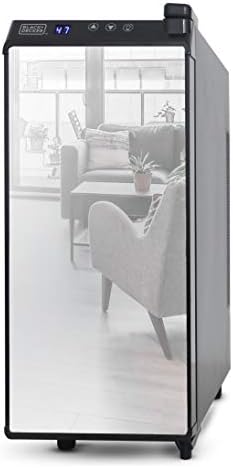
A compact cooler with mirrored glass and touch controls that leans into the display role, a frequent pick for sideboards and entertaining corners.
Setup and Everyday Use
Setup is five minutes: stand the unit in place, give it the clearance the manual asks for on each side, and set it in the commonly recommended serving bands, upper 40s to low 50s Fahrenheit for whites and sparkling, or the upper 50s if it holds reds. The full ranges, and why they are ranges rather than magic numbers, live in our wine storage temperature guide.
Treat the contents as a rotation, not a collection. This class exists to keep the next few weeks of wine ready to pour; anything you intend to keep for years deserves the stabler environment of a floor-standing compressor unit. Wipe the vents clear of dust occasionally, keep the glass out of direct sun, and the machine will quietly outlast your patience with it.
Common Mistakes to Avoid
- Putting a thermoelectric unit in a hot kitchen. Its interior temperature floats on the room’s. Warm room, warm wine, no matter what the display promises.
- Overloading light furniture. Unit plus bottles is a heavier package than it looks. Check what the surface can carry before you decide where it goes.
- Blocking the vents. Pushing the body hard against a wall or hemming it in with appliances traps the heat it needs to shed. Those few inches of clearance are load-bearing.
- Using it as long-term storage. Counter height, daylight, and room-linked temperatures make this the wrong tool for aging anything. Serve from it; cellar elsewhere.
- Ignoring the sun path. A door that catches afternoon sun undoes the cooling and bathes labels in the light wine dislikes. One check in summer prevents it.
Where to Go From Here
When the rotation outgrows the counter, the natural next steps are a floor-standing unit from our small wine fridge guide or, if the collection is genuinely growing, the full-size field in the best wine fridge roundup. If the counter corner is more about display than chill, a countertop wine rack does the visual work with zero watts.
Frequently Asked Questions
Can you put a wine fridge on a countertop? Yes, if the model is sized for it and the surface can take the loaded weight. The 6 to 12 bottle class is designed for counters; floor-standing compacts are not, mostly for weight and venting reasons.
Are countertop wine fridges any good? As serving stations, genuinely yes: they hold a rotation of bottles at drinking temperature in a tiny footprint. As long-term storage they are the wrong tool, which is most of where disappointment in the class comes from.
What temperature should a countertop wine fridge be? The commonly recommended serving bands: roughly upper 40s to low 50s Fahrenheit for whites and sparkling, upper 50s to low 60s for reds. Details in our temperature guide.
How many bottles fit in a countertop wine fridge? Typically 6 to 12 by the rating, which assumes slim Bordeaux bottles. Mixed collections with wider bottles fit fewer, so buy the 12 if you are torn between sizes.
Are countertop wine fridges noisy? The thermoelectric majority is close to silent, one of the class’s best features. Compact compressor models hum softly and cycle; at counter height, check owner comments if the room is a quiet one.
The Bottom Line
A countertop wine fridge earns its counter space as a serving station: a quiet 6 to 12 bottle unit holding the week’s wine at pouring temperature. Match the cooling to the room, thermoelectric for cool spaces and compressor for warm ones, respect the loaded weight, and keep it out of the sun. For anything you plan to keep, graduate to a floor-standing unit.