Last updated: August 12, 2026
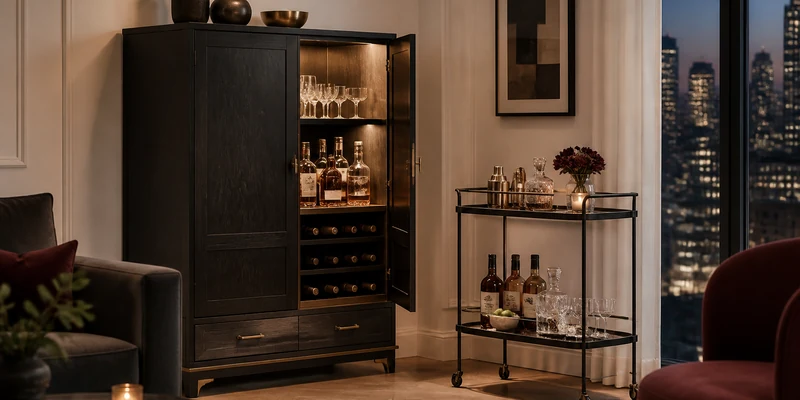
Bar cabinet vs bar cart is the first real decision in building a home bar, and it is worth getting right because the two pieces solve different problems that happen to share a category. One is furniture: closed storage, a permanent address, a considered presence in the room. The other is equipment: mobile, open, light on commitment, and rolled to wherever the evening is happening.
Most advice treats them as interchangeable styles. They are not. Your floor plan, hosting habits, storage volume, and even whether you rent or own all push toward one answer, and this comparison walks through each factor so you land on the right one the first time, or conclude, as plenty of households eventually do, that the real answer is both with different jobs.
Quick Answer
Bar cabinet or bar cart: which should you choose?
- Choose a cabinet if you have a permanent spot, more than a shelf of bottles and glassware, and want closed storage that hides clutter.
- Choose a cart if you rent, move often, host in different rooms, or are starting a first small setup.
- Many homes end up with both: cabinet as the home base, cart as the serving station that travels.
The Differences at a Glance
Every meaningful difference between the two formats, in one scan. The rows near the top decide the choice for most households.
| Factor | Bar cabinet | Bar cart |
|---|---|---|
| Storage capacity | Large: bottles, full glassware sets, tools, and backups behind doors | Small: a working set on two or three open shelves |
| Mobility | None; it is placed furniture | Full; rolls to the party, the patio door, the dining table |
| Clutter control | Closed doors hide everything | Everything visible all the time, tidy or not |
| Dust and light | Contents protected behind doors or glass | Open shelves collect dust; bottles sit in room light |
| Work surface | Counter-height top on most formats | Small top, often below comfortable mixing height |
| Commitment | An anchor piece you place once | Light, movable, easy to resell or repurpose |
| Child access | Doors slow access; lockable versions exist | Open shelves at exactly grabbing height |
| Typical cost level | Higher; it is real furniture | Lower entry point for a first setup |
Where the Cabinet Wins
Volume and order. A cabinet swallows a full collection, bottles, two or three glass types, tools, mixers, napkins, and presents a calm face to the room regardless of what chaos lives inside. That closed-door forgiveness is the single most underrated feature in the debate: a cart must be styled to look good, while a cabinet merely has to be shut.
Cabinets also win on function-per-use. The counter-height top of a sideboard-style cabinet is a genuine mixing surface, storage fittings like stemware rails and bottle slots keep everything findable, and glass-door versions add display with dust protection. For households with young children, doors add a meaningful barrier and locking versions close the question entirely. The cost is permanence: a cabinet claims its wall and keeps it.
Where the Cart Wins
Flexibility, price of entry, and charm. A cart rolls dinner service to the table, drinks to the living room, and lemonade to the porch, then tucks into a corner when the evening ends. For renters and frequent movers it is the obvious call: no wall anchoring, light to transport, and at home in whatever floor plan comes next. For a first bar of a half-dozen bottles, a cart is honest sizing, a cabinet that size would echo.
The cart’s openness is also its tax. Everything shows, so it demands ongoing editing and a little styling discipline, our guide on how to style a bar cart covers making that work for you, and dust plus direct light are constant companions for whatever lives on it. Bottles that matter should not summer on an open shelf by a bright window; our wine storage temperature guide explains why light and heat are the enemies of anything you plan to keep.
Which Host Are You?
Map yourself to the closest profile and the answer usually falls out on its own.
- The settled entertainer: own home, regular hosting, growing collection. Cabinet, without hesitation; start with the best bar cabinet guide.
- The renter starting out: first apartment, small collection, unknown next floor plan. Cart; the best bar cart guide covers every style and budget.
- The tight-space maximizer: storage needed, no wall to spare. A compact cabinet still beats a cart for volume; see small bar cabinet or, if even that is too much, bar cart for small spaces.
- The multi-room host: dinner parties that migrate from kitchen to table to sofa. Cart now, cabinet later; the cart keeps its serving job even after the cabinet arrives.
- The parent of small children: doors matter more than style points. Cabinet, ideally lockable, with the cart postponed a few years.
The Both-Pieces Endgame
Households that host regularly tend to converge on the same setup: a cabinet as the permanent home base holding the full collection, and a cart as the mobile serving layer stocked from it for each occasion. The division of labor is clean, storage versus service, and each piece does what it is actually good at instead of impersonating the other.
If that is your likely destination, buy the cabinet first. It is the harder purchase to get right, it removes the storage pressure that makes carts overflow, and a cart added later can be chosen purely for looks and mobility rather than forced into a storage role it handles badly.
Common Mistakes in This Decision
- Buying a cart to do a cabinet’s job. A collection that outgrows two shelves turns any cart into open clutter. Volume needs doors.
- Buying a cabinet you will move in a year. Heavy furniture and short leases argue for the cart until the floor plan settles.
- Choosing by photo instead of hosting habit. The styled cart photo is lovely; the question is whether you will maintain it weekly.
- Ignoring the children factor. Open shelves at toddler height are a real consideration, not a detail.
- Parking either in direct sun. Both formats suffer, but the cart’s open shelves expose bottles completely. Interior walls for both.
- Forgetting the mixing surface. If you actually mix drinks, a counter-height cabinet top beats crouching over a cart shelf every time.
Frequently Asked Questions
Is a bar cabinet worth it over a bar cart? If you have a permanent spot and more than a shelf of gear, yes: the storage, closed doors, and real work surface outclass any cart. The cart wins on mobility, entry price, and low commitment.
Can a bar cart hold a full home bar? Only a very edited one. Two or three open shelves hold a working set, not a collection with glassware and backups. Growth pushes almost everyone toward doors eventually.
What is better for a small apartment? Whichever matches your bigger constraint: a compact cabinet stores more per square foot and hides clutter, while a cart can vanish into a corner and move at lease’s end. See small home bar ideas for setups that make both work.
Do people have both a cabinet and a cart? Commonly, once hosting becomes regular: the cabinet stores, the cart serves. Buying the cabinet first makes the second purchase easier and purely aesthetic.
Which holds its looks longer? The cabinet, structurally and visually: closed storage forgives mess, and furniture-grade builds age well. A cart looks exactly as good as its last tidy-up.
The Bottom Line
Cabinet for storage, permanence, and hidden clutter; cart for mobility, low commitment, and first setups. Decide by hosting habit and floor plan rather than photos, and know that regular hosts usually end up with both, cabinet as home base, cart as the serving layer. Whichever you choose first, buy it for the job it is actually good at.