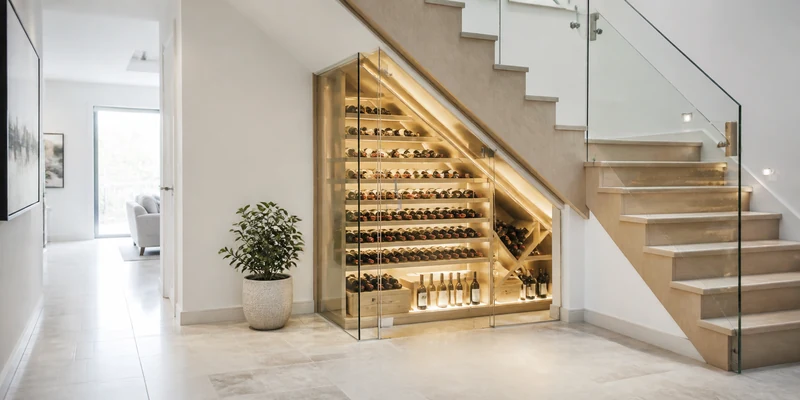
Last updated: August 12, 2026
Every staircase manufactures the same piece of real estate: an awkward, sloping triangle that furniture refuses to fit and vacuum cleaners end up colonizing. Under stairs wine storage is the interiors world’s favorite answer to that triangle, and for good reason. Bottles do not care about sloped ceilings, racks scale down gracefully into the low corner, and the result photographs like a built-in cellar even when it is really a weekend project.
This guide covers the three ways to turn the dead space under a staircase into wine storage, what the spot is honestly good for and what it is not, and the off-the-shelf pieces that get you the magazine look without a contractor.
This article contains affiliate links. If you buy through them, we may earn a commission at no extra cost to you. Learn more.
Quick Answer
How do you turn the space under the stairs into wine storage?
- Three routes: a label-forward display wall on the stair face, modular racks filling the triangle underneath, or an enclosed, conditioned mini cellar if the budget allows.
- Off-the-shelf wall rails and stackable modules deliver the built-in look without carpentry; the slope becomes a feature instead of a problem.
- Check the conditions first: a hallway staircase near heat and sun is display territory, while a cool, dark under-stairs void can store wine seriously. Our wine storage temperature guide tells you which one you have.
Three Ways to Do It
Under-stairs projects fall into three tiers of ambition. All three can look spectacular; they differ in cost, permanence, and how seriously they treat the wine.
| Approach | What it is | Effort | Best when |
|---|---|---|---|
| Display wall | Label-forward rails mounted on the stair wall, bottles as art | An afternoon and a stud finder | You want the showpiece and drink your bottles within months |
| Modular fill | Stackable racks stepped down to follow the slope of the triangle | A weekend, no carpentry | You want real capacity from the dead space, cheaply |
| Enclosed mini cellar | The void closed off, insulated, often with a cooling unit and glass door | A contractor and a real budget | You collect seriously and the staircase is the showcase spot |
Most readers land on the first two, often combined: rails on the wall for the look, modules in the void for the volume. That combination is what the picks below are built around.
Is Under the Stairs Actually Good for Wine?
Honest answer: it depends on which staircase you have. The commonly recommended conditions for keeping wine are cool, stable, dark, and calm, and an under-stairs void in a basement or a shaded hallway can deliver those surprisingly well; it is enclosed on most sides, naturally dark, and away from kitchen heat. That kind of spot can host bottles that wait patiently for years.
A staircase in a bright, warm living area is a different animal. Sunlight from a nearby window and everyday household warmth make it a display and rotation spot: perfect for the wine you will drink this season, wrong for the case you are aging. Vibration from footsteps on the stairs, for what it is worth, is a modest factor compared with heat and light; do not let it scare you off, but do not park your longest keepers against the stringer of the busiest staircase in the house either. Sort your bottles accordingly, and give the long-term keepers a wine fridge or a cooler room.
Get the Look: The Three Pieces That Build It
How we chose: these are the product types that under-stairs projects lean on again and again in real installs, selected for mounting flexibility on angled walls, modularity in tapering spaces, and consistent owner reports of clean results. We work from specifications and recurring review themes, not our own builds.
🖼️ The Display Wall
VintageView’s label-forward rails are the signature of the under-stairs look: slim metal columns that follow the stair slope in stepped runs, storing bottles horizontally while facing their labels into the room.

🧩 The Triangle Filler
Stackable wooden modules, stepped down tier by tier, are how you fill a sloping void without a saw. Start tall at the deep end, shrink toward the low corner, and the taper looks intentional.

🥂 The Finishing Touch
A freestanding rack with a serving top at the open end of the nook turns storage into a small tasting station: bottles below, decanter and glasses above, right where the display begins.

Planning the Space: Measure the Triangle First
Under-stairs geometry punishes guesswork, so spend twenty minutes with a tape measure before spending anything else. Record the height at the tall end, the height where the slope meets the floor, and the depth front to back; then sketch the triangle and block in rack heights against it. Stepped modular stacks want their tallest column at the deep end, and wall rails want an uninterrupted run of wall, so note where studs, outlets, and trim interrupt the surface.
Wall-mounted elements follow the same safety rules as any loaded rack: full bottles weigh around three pounds each, so rails carrying a stepped run of them must be screwed into studs or properly rated anchors, never bare drywall. The full installation routine, stud finding, anchor choice, and load checks, is covered in our wall mounted wine rack guide. Renters can skip the drilling entirely and still get most of the look with freestanding stepped stacks, which leave nothing behind but an empty triangle.
Making It Look Built-In
The difference between “racks under the stairs” and “custom wine wall” is mostly finish discipline. Paint the back wall of the void a deep, uniform color, navy, charcoal, or oxblood reads instantly as cellar, so the bottles pop and the hardware disappears. Match your rack finish to one material story, all black metal or all warm wood, rather than mixing; the eye forgives a taper, not a jumble. Warm strip lighting under the stair nosing or along the top of the void adds the glow the photos always have; choose a low-heat LED option and keep the light indirect, since strong light on bottles works against the storage.
Finally, resist filling every inch. A display works because of breathing room: one stepped rail run, one clean stack, one serving surface. If the collection outgrows the triangle, that is what the rest of the house, and our wine rack guide, are for.
Common Mistakes to Avoid
- Building before measuring the slope. The triangle is less roomy than it looks; sketch it with real numbers first.
- Treating a warm hallway like a cellar. Sunny, warm staircases are for display and rotation, not for aging your good cases.
- Mounting rails into bare drywall. A stepped run of full bottles is serious weight; studs or rated anchors, no exceptions.
- Mixing rack styles and finishes. One material story is what makes off-the-shelf parts read as custom.
- Aiming spotlights at the bottles. Light flatters the display and harms the wine; keep it warm, dim, and indirect.
- Blocking a passage or the stair structure. Leave walking clearance, and never modify stair framing for a rack; the staircase outranks the wine.
If You Are Building a Whole Bar Around It
An under-stairs wine wall rarely stays alone; it tends to become the anchor of a larger corner. If the plan is growing in that direction, our small home bar ideas shows how to build a full setup around compact spaces, and basement bar ideas covers the downstairs version, where the under-stairs void often already lives. For the storage itself, the wine rack guide compares every format the triangle might borrow from.
Frequently Asked Questions
Is it OK to store wine under the stairs? Yes, if the spot is cool, dark, and stable; basement and shaded hallway voids often qualify. Warm, sunlit staircases are better used as display for bottles you will drink within months. Our wine storage temperature guide helps you judge your spot.
How many bottles fit under a staircase? It varies enormously with the geometry, from a few dozen on a single rail run to several hundred in a fully racked walk-in void. Measure the triangle and count slots from the racks you plan, not from hope.
Do I need a contractor for under stairs wine storage? Not for the two most popular versions. Wall rails and stepped modular stacks are afternoon-and-weekend projects; only an enclosed, cooled mini cellar calls for building work.
Does vibration from the stairs harm wine? Footfall vibration is a minor factor compared with heat and light. It is sensible to keep decades-long keepers somewhere calmer, but for everyday collections it is not a reason to skip the space.
What racks work best on the angled wall? Label-forward rail systems, mounted in stepped columns that follow the stair slope. Our VintageView wine rack review looks at the system most of these installs use.
Can renters do this? Yes: freestanding stepped stacks fill the triangle without a single hole, and a console at the open end completes the look. Everything walks out with you at the end of the lease.
The Bottom Line
Under stairs wine storage turns the house’s most useless triangle into its best-looking corner: rails on the wall for display, stepped modules for capacity, and paint and lighting to make it read as built-in. Judge the conditions honestly, mount into studs, and keep the long keepers somewhere cool. The staircase does the architectural work; you just add bottles.