Last updated: August 12, 2026
Every wine fridge size guide question is really two questions wearing one coat: how many bottles do you need to store, and how much of your home are you willing to give the machine that stores them? Bottle ratings make the first question look easy, but they hide a catch, because those ratings are measured with slim standard bottles that your actual collection probably does not match.
This guide lays out the real size classes, what each one holds honestly, the floor space it claims, and the simple counting method that lands you on the right capacity the first time instead of the second.
Quick Answer
What size wine fridge do you need?
- Count your realistic peak collection, add roughly a third for growth, and discount the rated capacity by a few bottles for every mixed-shape collection.
- The 24 to 50 bottle class fits most households; 6 to 18 bottles suits counters and rotations, and above 100 you are in collector territory.
- Widths cluster at 15 and 24 inches for built-ins; freestanding towers grow taller, not wider, as capacity climbs.
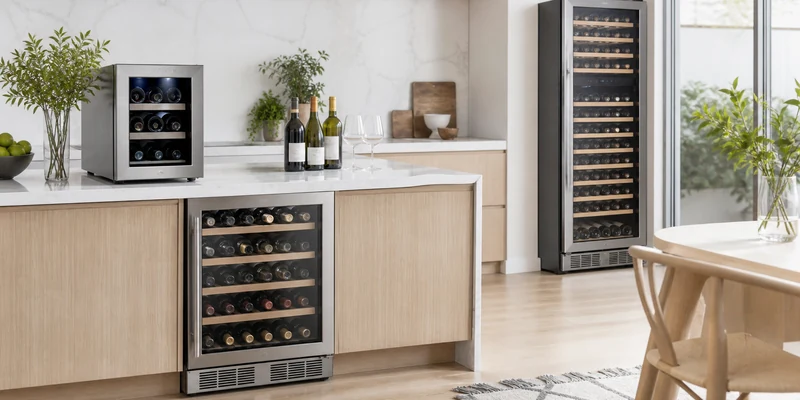
Wine Fridge Size Classes at a Glance
Save this table; it maps ratings to reality for the whole market.
| Class | Rated bottles | Typical form | Best for |
|---|---|---|---|
| Countertop | 6 to 12 | Counter-scale box, often thermoelectric | A serving rotation next to the glasses; not storage |
| Compact | 12 to 24 | Freestanding floor unit, roughly mini-fridge footprint | Apartments, bar corners, first fridges |
| Mid-size | 24 to 50 | 15 or 24 inch built-in, or slim freestanding tower | Most households; the market’s center of gravity |
| Large | 50 to 100 | Tall freestanding or wide built-in cabinet | Enthusiasts, wine club members, entertainers |
| Collector | 100 plus | Full-height tower, often two-door dual zone | Serious collections replacing a cellar |
Note that the classes also sort by cooling reality: countertop units are often thermoelectric with the room-temperature limits that brings, while everything from compact up should be compressor cooled, a distinction our wine fridge buying guide weighs model by model.
Why Rated Capacity Lies a Little
Manufacturers count capacity in standard Bordeaux bottles, the slim, straight-shouldered format that stacks densest. Your pinot noir and Champagne bottles are wider and rounder, and every one of them borrows space from its neighbors. In practice, a mixed collection fits noticeably fewer bottles than the rating, with shelf layouts deciding how gracefully the loss lands; some designs sacrifice a whole row, others just a few slots.
The honest arithmetic is simple: subtract a few bottles per shelf of wide formats, and if bubbles and Burgundy dominate your habits, treat the rating as optimistic by a shelf or more. Capacity-focused designs with flexible shelving handle mixed bottles best, which is a large part of the pitch behind brands like Allavino, covered in our Allavino review.
The Counting Method That Gets It Right
Forget averages; count your own peaks. Note how many bottles are in the house today, add what a normal buying trip or club shipment lands at once, and take the highest number the last year realistically hit. That is your working peak.
Then add a third, because collections grow to fill their containers, and a fridge bought exactly at today’s peak is full at the housewarming. Finally, apply the mixed-bottle discount from above to the rated capacities you compare. The method sounds almost too plain, and it prevents the two classic regrets of the category: the cramped 12 bottle unit outgrown in a season, and the half-empty tower humming for six bottles.
From Bottle Count to Floor Plan
Capacity picks the class; your floor picks the body. Built-in widths cluster at 15 and 24 inches to match standard cabinet openings, and only front-venting models may be enclosed at all, the rule our under counter guide and the freestanding versus built-in comparison explain in full. Freestanding units grow upward with capacity: compacts stand knee-high to waist-high, mid-size towers reach chest height, and collector cabinets are furniture-scale objects that claim a wall.
Wherever the fridge lands, add the clearances from the installation sheet to your measurements, plus door swing room in front, and remember the loaded weight: at roughly 3 pounds per bottle plus the cabinet, a large unit is a one-location decision, not something rearranged on a whim.
Common Mistakes to Avoid
- Believing the rating for a mixed collection. Bordeaux-bottle math flatters every spec sheet. Discount for your real bottle shapes before comparing models.
- Buying today’s collection exactly. No growth headroom means shopping again within the year. A third extra is the cheap insurance.
- Sizing to the space instead of the wine. A giant cabinet for a small habit stores mostly air at a monthly electricity cost; the right size is the one your bottles justify.
- Forgetting height and weight at the big end. Collector towers need ceiling clearance, strong floors, and a freight delivery path. Measure the route, not just the destination.
- Ignoring zones in the size decision. Dual zone splits capacity in two; a 46 bottle dual zone holds roughly 23 per color. If one zone must hold your whole red collection, size the whole unit up. Our dual zone guide covers the layout logic.
Where to Go From Here
With a size class in hand, the model choice is the easy half: the full field is ranked in our best wine fridge guide, the compact end gets its own treatment in the small wine fridge roundup, and whatever you buy, set it by the ranges in the wine storage temperature guide. If part of the collection is display rather than storage, a wine rack absorbs the overflow beautifully.
Frequently Asked Questions
How many bottles does a standard wine fridge hold? The market’s center is the 24 to 50 bottle class, with ratings measured in slim Bordeaux bottles. Mixed collections fit somewhat fewer, so most households do well rating-shopping in the 30s and 40s.
What are standard wine fridge dimensions? Built-in units cluster at 15 and 24 inch widths to match cabinet openings, sized to slide under standard counters. Freestanding units vary freely and grow taller as capacity climbs; the installation sheet’s dimensions are always the ones to trust.
Is a 12 bottle wine fridge big enough? For a rotation of weeknight bottles, yes. As the only storage for someone who buys by the case or belongs to a wine club, it is the classic outgrown-in-a-season purchase.
Do Champagne bottles fit in a normal wine fridge? Usually, but they cost capacity: wider bottles take neighboring slots and some shelf designs handle them poorly. Bubbly-heavy collections should favor flexible shelving and discount the rating by a shelf.
Does dual zone reduce capacity? The bottle total stays as rated, but it is split between two compartments. Size the unit so your larger color collection fits its zone, not just so the total matches.
The Bottom Line
Sizing a wine fridge is one honest count and two corrections: your realistic peak collection, plus a third for growth, minus a discount for every wide bottle the rating pretends you do not own. That lands most households in the 24 to 50 bottle class, counters at 6 to 18, and collectors past 100. Measure the spot with clearances included, and buy once.