Last updated: August 12, 2026
Keg sizes are the first vocabulary lesson of draft beer at home, and the names do not help: half barrels, quarter barrels, pony kegs, sixtels, slim quarters, Cornelius kegs. Buy a kegerator without understanding them and you can end up with a cabinet that cannot hold the keg your local brewery actually sells.
The good news is that the whole system reduces to a handful of standard formats, and once you can picture them, every kegerator listing suddenly makes sense. This guide lays out the sizes, what each one holds, which kegerators fit which kegs, and how to pick the format that matches how often you actually pour.
Quick Answer
What are the standard keg sizes?
- Half barrel: the full-size keg, about 15.5 gallons, roughly 165 twelve-ounce pours. Fits full-size kegerators only.
- Quarter barrel: about 7.75 gallons, in a squat “pony” shape or a tall “slim” shape.
- Sixth barrel (sixtel): about 5.2 gallons, tall and narrow, the format most craft breweries sell and the one compact and dual tap kegerators are built around.
Keg Sizes Compared
Save this table: it answers nearly every sizing question that comes up when you shop for a kegerator or order a keg. Figures are approximate, since exact dimensions vary slightly by manufacturer.
| Keg | Volume | Approximate size | Roughly how many pours |
|---|---|---|---|
| Half barrel | 15.5 gallons | About 23 in tall, 16 in wide | Around 165 twelve-ounce servings |
| Quarter barrel (pony) | 7.75 gallons | About 14 in tall, 16 in wide | Around 82 twelve-ounce servings |
| Slim quarter | 7.75 gallons | About 23 in tall, 11 in wide | Around 82 twelve-ounce servings |
| Sixth barrel (sixtel) | 5.2 gallons | About 23 in tall, 9 in wide | Around 55 twelve-ounce servings |
| Cornelius (corny) | 5 gallons | About 23 in tall, 9 in wide | Around 53 twelve-ounce servings |
| 50 liter (import) | About 13.2 gallons | Close to a half barrel | Around 140 twelve-ounce servings |
The Formats, Translated
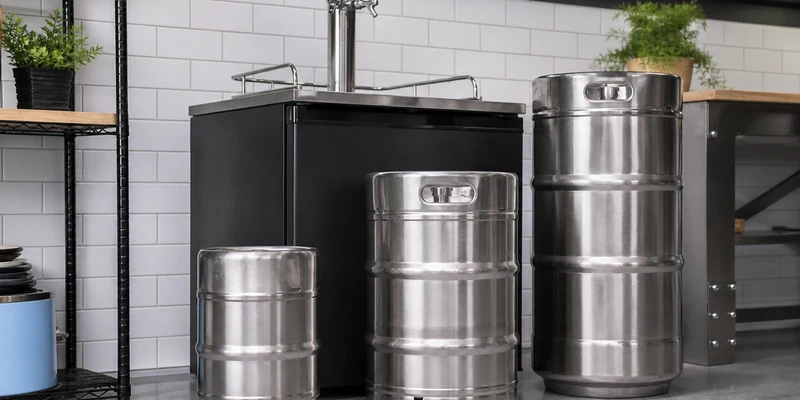
The half barrel is the keg you picture from bars and college stories: wide, heavy, and the standard unit of the beer industry. It offers the lowest cost per pour and the most beer on hand, at the price of bulk, weight, and commitment to one style for a long stretch. The quarter barrel splits into two shapes with identical volume: the squat pony keg, which shares the half barrel’s wide footprint, and the slim quarter, which stands half-barrel tall on a much narrower footprint.
The sixth barrel, or sixtel, is the format that quietly took over home draft. It is tall, narrow, light enough to load without a second person, and it is what most craft breweries fill for retail. Two sixtels fit side by side where one half barrel sits, which is the entire premise of the dual tap kegerator. The Cornelius keg, or corny, is its homebrew cousin: a five gallon former soda keg with ball lock or pin lock posts instead of a standard valve, filled at home rather than bought filled. And the 50 liter keg is the European import format, close to a half barrel and mostly encountered with imported brands.
Couplers: the detail that trips people
Size is only half the compatibility question. Commercial American kegs, from half barrels down to sixtels, use the American Sankey D valve, which is why one coupler covers nearly everything you buy filled. Cornelius kegs use ball lock or pin lock disconnects instead, so homebrew setups need different fittings, not just different space. Some European imports use their own coupler types, worth checking before you special-order a keg of a favorite import.
Which Kegerator Fits Which Keg
Full-size kegerators are built around the half barrel, and anything that fits a half barrel also fits every smaller format, though a short pony keg may need the beer line to reach lower. Compact and countertop-style units are built for the tall narrow formats, sixtels and corny kegs, and cannot take the wide-footprint half barrel or pony at all. Dual tap cabinets typically run two sixtels or two corny kegs side by side; our dual tap kegerator guide covers that layout in detail.
When you compare a specific cabinet, use interior dimensions and remember the coupler: it adds several inches above the keg, and the beer line needs an unkinked path from coupler to tower. A cabinet listed at just over keg height fits the keg and not the keg plus coupler. The same math applies, more strictly, to DIY builds, where the donor fridge was never designed around a keg; our conversion kit guide walks through measuring a fridge honestly before you drill it.
Choosing Your Size: Drink Rate Beats Party Size
The instinct is to size the keg for your biggest party of the year; the better move is to size it for an ordinary month. Draft beer under CO2 stays in good condition for weeks, commonly a few months for pasteurized beers and less for unpasteurized craft beer, but it is not indefinite, and a half barrel that takes half a year to empty will not finish as well as it started. A household that pours a few beers a week is a sixtel household, and the fresher rotation means more variety across the year anyway.
Choose the half barrel when the math genuinely supports it: frequent hosting, multiple regular drinkers, or a beer everyone in the house agrees on. Choose two sixtels on a dual tap when variety matters more than volume. And if you are still choosing the machine around the keg, our kegerator buying guide sorts the cabinets by exactly these situations.
Common Sizing Mistakes
- Buying the keg your party needs, not the keg your month needs. Freshness rewards the smaller format; parties can always add a second keg.
- Comparing keg height to cabinet height without the coupler. The coupler and line need several inches above the keg. Use interior dimensions with hardware in mind.
- Assuming all quarter barrels are the same shape. A pony keg and a slim quarter hold the same beer in completely different footprints. Only one of them fits where a sixtel fits.
- Forgetting couplers on homebrew kegs. A corny keg fits the space of a sixtel but not the fitting. Ball lock and Sankey are different systems.
- Ignoring weight. A full half barrel is a two-person object. If the kegerator lives down a basement stair, the sixtel earns its popularity fast.
- Special-ordering an import without checking the coupler type. Some European kegs need their own coupler; confirm before the keg is on your doorstep.
Putting It Together
Once the size question is settled, the rest of the draft setup follows: the cabinet that fits your format, covered by situation in our kegerator guide, and the small maintenance rhythm that keeps every one of those pours clean, laid out in how to clean kegerator lines. Sizing is the decision you make once; those two are the ones you live with.
Frequently Asked Questions
How many beers are in a full keg? A half barrel holds about 15.5 gallons, which works out to roughly 165 twelve-ounce servings or about 124 pints. Real-world counts run slightly lower once foam and pours are imperfect.
What keg size do most craft breweries sell? The sixth barrel, or sixtel: about 5.2 gallons and roughly 55 twelve-ounce pours, in a tall narrow shape that fits compact and dual tap kegerators.
What is the difference between a pony keg and a slim quarter? Volume is identical at about 7.75 gallons; the shape is not. The pony is short and wide like a half barrel, the slim quarter is tall and narrow like a sixtel, and cabinets that fit one often do not fit the other.
What size keg fits in a standard kegerator? Full-size units fit a half barrel and everything smaller; compact units are limited to sixtels and Cornelius kegs. Dual tap layouts usually mean two of the tall narrow formats side by side, as covered in our dual tap kegerator guide.
How long does a tapped keg last in a kegerator? Dispensed with CO2 at a steady serving temperature, commonly several weeks to a few months, with pasteurized beers on the longer end. A keg on a party pump with hand-pumped air, by contrast, is a same-day affair.
The Bottom Line
Keg sizing comes down to three formats: the half barrel for volume, the sixtel for freshness and flexibility, and the Cornelius for homebrew, with quarter barrels splitting the difference in two different shapes. Match the format to your ordinary month, check interior clearance with the coupler attached, and the rest of the draft setup falls into place around it.