Last updated: August 12, 2026
A small home bar is not a scaled-down version of somebody’s basement build. It is its own discipline, and honestly, it is often the better-looking one. When you only have a corner, a slice of wall, or two feet beside the bookcase, every choice has to earn its footprint, and the result tends to be tighter, more intentional, and more used than many full bar rooms.
This guide collects the small home bar ideas that hold up in real apartments, condos, and compact houses: which formats fit which spaces, how a small home bar cabinet compares to a cart or a shelf, and the editing rules that keep two square feet of bar from becoming two square feet of clutter.
Quick Answer
How do you set up a home bar in a small space?
- Pick one format and commit: a slim bar cabinet for closed storage, a cart for flexibility, or wall shelves when the floor is spoken for.
- Go vertical. Tall, narrow pieces store more per square foot than wide ones, and the wall above any surface is free real estate.
- Edit the inventory. A small bar with six well-chosen bottles and the right glasses outperforms a crowded one every night of the week.
Small-Space Bar Formats Compared
Match your available space to a row. The footprints are approximate, but the trade-offs are the real content of this table.
| Format | Footprint | Trade-off |
|---|---|---|
| Tray bar on existing furniture | None | Zero commitment, zero storage; everything stays on display |
| Bar cart | About two feet square | Mobile and stylish, but open shelves demand tidiness |
| Slim or corner bar cabinet | Two to three feet of wall | Closed storage hides clutter; heavier and stays put |
| Wall-mounted shelves or cabinet | Wall only | Frees the floor entirely; weight limits and landlord approval apply |
| Console or bookcase conversion | Furniture you already own | Free and immediate; storage was not designed for bottles |
| Closet or nook mini bar | An existing recess | The built-in look on a budget; needs light and airflow added |
The cabinet-versus-cart question is the fork most small-space buyers face, and it deserves more than a table row; our bar cabinet vs bar cart comparison settles it by lifestyle. If closed storage wins, the compact end of the market is covered in our small bar cabinet guide.
Think in Vertical Inches, Not Square Feet
The defining move of good small-bar design is trading floor for wall. A tall, narrow cabinet stores dramatically more than a wide, low one on the same footprint, and the wall above any cart, console, or cabinet will happily hold two shelves of glassware that would otherwise occupy a cupboard. Corner formats push the same logic sideways: the angle between two walls is space almost nothing else in the room wants.
Height has a hosting bonus, too. Bars work best at counter height or above, standing height feels social in a way coffee-table service never does, and tall furniture puts the pouring surface right where hands expect it. When you shop, favor pieces that stack function vertically: bottles low, working surface in the middle, glasses up top. That single pattern is most of what separates purpose-built bar furniture from a repurposed shelf, and it is exactly what the formats in our best bar cabinet hub are organized around.
Ideas by Space: Where Small Bars Hide
In living rooms, the classic spots are the wall behind the sofa, the awkward gap beside the media unit, and the corner the floor lamp was not really earning. A slim cabinet or cart in any of them reads as furniture first and bar second, which is exactly right for a shared space. In dining areas, one end of a sideboard, or a dedicated compact cabinet beside it, turns serving dinner and serving drinks into the same motion.
Rental-friendly moves
Renters get the cart, the tray, and the freestanding cabinet, everything that moves out when you do. A bar cart is the category champion here: real storage, real style, no holes in the wall, and our bar cart for small spaces roundup covers the slim end of that market. If the look matters as much as the function, how to style a bar cart keeps the open shelves working for you instead of against you.
The reclaimed nook
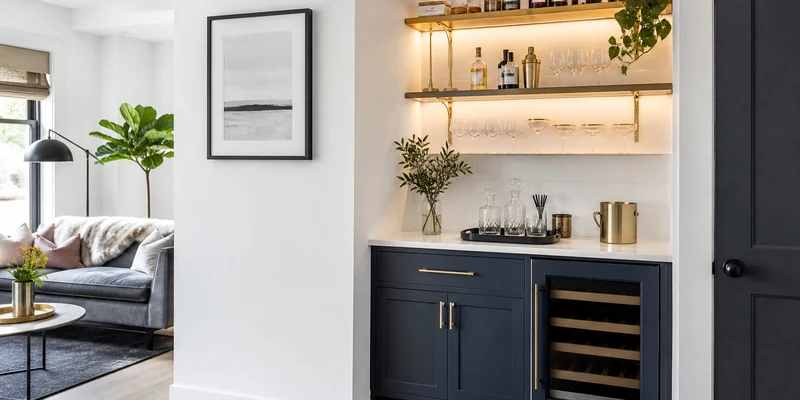
The most satisfying small bars occupy space that was previously nothing: a shallow closet with the rod removed, the recess beside a chimney breast, the dead end of a hallway. Add a counter-height surface, warm light, and shelves above, and the architecture provides the drama. These builds cost more effort than furniture but less money, and they make small homes feel designed rather than furnished.
Stock Small: The Editing Rules
A small bar succeeds by curation. Six to eight bottles you actually pour cover the overwhelming majority of home drinks; the rest is display weight that a two-foot bar cannot afford. Apply the same discipline to glassware, two types you really use beat six types you own, and to tools, where one good tray corrals everything and doubles as the serving surface. Rotate rather than accumulate: when a new bottle comes in, an unloved one goes to the back of a kitchen cupboard.
Refrigeration is the honest limit of the tiny bar, and the answer is usually the kitchen, a compact fridge nearby, or ice made in batches before guests arrive. That is fine. A small bar is a station, not a self-sufficient bunker, and pretending otherwise is how carts end up buried. For the full checklist of what belongs at any size of setup, home bar essentials sorts the genuinely necessary from the merely shiny.
Common Small Home Bar Mistakes
- Buying wide when you should buy tall. Floor space is the scarce resource. A tall slim cabinet out-stores a squat wide one and leaves room to live.
- Choosing open storage with a maximal collection. Open shelves plus twenty bottles equals visual noise. Either edit the bottles or close the doors.
- Blocking a walkway for a bar. A cart in a traffic path gets bumped, resented, and eventually exiled. Corners and dead zones only.
- Ignoring weight on wall-mounted setups. Bottles and glass are heavy; anchor into studs and respect the shelf’s rating, especially as a renter.
- Duplicating the kitchen. If the kitchen is eight steps away, the bar does not need its own ice bucket, fridge, and sink. Let rooms share.
- Styling for the photo, restocking for nobody. The best small bar holds what your household pours. Curate for your actual Tuesdays.
Where to Go From Here
If closed storage is the priority, our small bar cabinet guide compares the compact cabinets worth the footprint. If flexibility wins, bar cart for small spaces covers the rolling route. And if you are still torn between the two philosophies, bar cabinet vs bar cart makes the call for your space and habits.
Frequently Asked Questions
How do I make a home bar in a small apartment? Choose one compact format, a cart, a slim cabinet, or wall shelves, place it in a corner or dead zone near where you host, and stock a curated six-to-eight-bottle lineup. Vertical storage and ruthless editing do the rest.
What is the smallest practical home bar? A tray on existing furniture: bottles, two glasses, and a tool or two. It costs nothing, proves the habit, and upgrades naturally to a cart or small cabinet when it earns the space.
Should I get a bar cart or a bar cabinet for a small space? Carts win on flexibility and price; cabinets win on closed storage and a furniture presence. Open shelves suit editors, doors suit collectors; our bar cabinet vs bar cart guide breaks the decision down fully.
Where should a small home bar go? A corner, an unused wall slice, or a reclaimed nook near your seating area, and out of every walkway. Proximity to the kitchen is a feature, not a failure, since the rooms can share ice and rinsing duty.
How many bottles should a small home bar have? Six to eight working bottles cover most household pours. Rotate new arrivals in and unused bottles out to a cupboard, and let the bar display only what earns its shelf space.
The Bottom Line
A small home bar wins by choosing one right-sized format, stacking storage vertically, and editing the inventory down to what actually gets poured. Corners, wall slices, and reclaimed nooks are the natural habitats; walkways and maximal collections are the natural enemies. Two well-planned square feet make a better bar than an unplanned room.