Last updated: August 12, 2026
Do you need a wine fridge, or is it another appliance that looks essential online and gathers dust at home? The honest answer depends on two things nobody’s marketing department wants to lead with: how long your bottles actually sit before being opened, and where they sit in the meantime. For some households a wine fridge is the most-used machine in the room; for others a cool closet does the same job free.
This article gives you the plain-spoken version: what a wine fridge actually solves, who genuinely benefits, who does not, and how to decide in a few minutes with the collection you have today, not the cellar you imagine someday.
Quick Answer
Do you need a wine fridge?
- Yes, if you regularly keep a dozen or more bottles for months, your home runs warm, or you care that wine is at serving temperature when opened.
- No, if you buy bottles days before drinking them and your home has a consistently cool, dark spot; a rack there does the job.
- The fridge solves three storage problems at once: steady temperature, darkness, and freedom from vibration.
Who Benefits and Who Does Not
Find your row. This table settles the question for most people faster than any feature list.
| Your situation | Verdict | Why |
|---|---|---|
| Bottles are opened within days of buying | No fridge needed | Short stays in imperfect conditions do no meaningful harm; chill whites in the kitchen fridge before serving |
| A dozen-plus bottles wait weeks to months | Fridge earns its keep | Steady mid-50s Fahrenheit holding beats a kitchen that swings with the seasons |
| You keep anything worth aging | Fridge, clearly | Years of storage magnify every temperature swing, light exposure, and vibration |
| Home runs warm, or bottles live near the kitchen | Fridge recommended | Sustained warmth is the classic enemy of stored wine, and kitchens are the warmest rooms |
| You have a cool, dark, stable closet or basement | Rack there may suffice | A naturally cellar-like spot does the fridge’s main job for free |
| You mostly want bottles ready to pour for guests | Fridge, for serving | Holding whites and reds at their serving ranges is the everyday luxury of the machine |
What a Wine Fridge Actually Solves
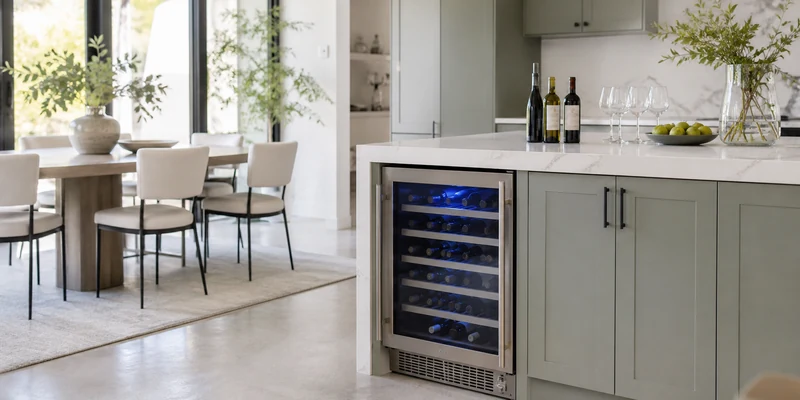
Strip the marketing and a wine fridge does three things a living room cannot. It holds a steady temperature, commonly recommended around 55 degrees Fahrenheit for storage, where a home swings daily and seasonally. It keeps bottles dark behind tinted glass, protecting wine from the light exposure that can degrade it over time. And it isolates bottles from the vibration of daily life, a factor cellar designers take seriously for long-stored wine.
Notice what is not on the list: making wine better. A fridge preserves what you bought; it upgrades nothing. That is why the buy-Tuesday-drink-Friday household gains so little, and why the keep-for-months household gains so much. The full reasoning behind the temperature numbers lives in our wine storage temperature guide, the companion piece to this one.
Why the Kitchen Refrigerator Is Not the Answer
The usual objection is that a perfectly good refrigerator already hums in the kitchen. For serving whites tonight, it is fine. As storage, it works against wine on every axis: it runs colder than wine likes, its air is dry enough to trouble corks over long stays, and the door opens dozens of times a day, jostling bottles and swinging the temperature.
The other free option, the countertop rack, fails differently: room temperature in most homes sits well above storage ranges and moves with the seasons, and daylight does the rest. A rack is furniture and short-term staging, genuinely useful as both, which is why racks and fridges coexist in most serious setups rather than competing. Our wine rack guide covers that side of the equation.
The Honest Cases Against Buying One
A wine fridge is the wrong purchase in three common situations. First, the fast rotation: if bottles rarely survive a week in your home, storage conditions barely register, and the money is better spent on the wine. Second, the natural cellar: a consistently cool, dark basement corner or interior closet replicates most of what the machine offers, and a simple rack there is the elegant answer. Third, the aspirational buy: purchasing a 46 bottle cabinet for a six bottle habit mostly stores air at a monthly electricity cost.
There is also the placement reality check. A fridge needs an outlet, ventilation clearance, and a spot away from sun and heat sources, and the compressor hums. If the only available corner fails those tests, the purchase fights the home instead of serving it.
If the Answer Is Yes: How to Start Smart
Start smaller than your ambition but larger than your current shelf. The commonly repeated mistake runs in both directions: buying a giant cabinet for a modest habit, or a 12 bottle unit that overflows by the second wine club shipment. Count what you realistically hold at peak, add a third for growth, and let that number pick the class; our wine fridge size guide translates it into real dimensions.
Then decide placement before brand: freestanding units need breathing room, and only front-venting models can be enclosed in cabinetry. With size and placement settled, choosing the actual machine is the easy part, and our wine fridge buying guide ranks the field by exactly those situations.
Common Mistakes to Avoid
- Buying for the imagined future cellar. Size to your real peak plus a third, not to a collecting hobby you have not started yet.
- Treating it as a status purchase. An unplugged or half-empty cabinet is the most expensive wine rack in the house.
- Skipping the placement check. No outlet, no clearance, or a sunny wall turns a good machine into a struggling one.
- Using the kitchen fridge as a cellar. Fine for this week’s whites, wrong for anything staying longer than that.
- Confusing serving and storage jobs. A tiny countertop unit that holds six bottles at pouring temperature does not make a storage problem go away, and a storage cabinet in the basement does not put cold white in your hand; know which job you are buying for.
Frequently Asked Questions
Is a wine fridge worth it for cheap wine? Price is not the test; time is. Any wine you hold for months benefits from steady, cool, dark storage, and any wine opened within days barely notices its surroundings.
How many bottles justify a wine fridge? As a practical threshold, a standing collection of a dozen or more bottles that wait weeks or longer is where the machine starts earning its space and electricity.
Can I store wine in a regular closet instead? If the closet stays cool, dark, and vibration-free year round, it is a legitimate free alternative for medium-term storage. The catch is the year-round part; most closets track the seasons more than people expect.
Does a wine fridge use much electricity? Compact units draw modestly, comparable to other small appliances, and placement matters: a fridge out of the sun and away from heat sources cycles far less than one fighting a warm wall.
Is a wine fridge the same as a beverage fridge? No. Beverage fridges run colder for cans and hold bottles upright; wine fridges hold gentler, commonly recommended wine temperatures with bottles on their side. The overlap is smaller than the showroom suggests.
The Bottom Line
You need a wine fridge if bottles wait in your home: a dozen or more held for weeks, anything meant for aging, or a household that likes wine ready to pour. You do not need one for a fast rotation or if a genuinely cool, dark closet already exists. Decide with the collection you have, size it with a third of headroom, and place it before you brand-shop.