Last updated: August 12, 2026
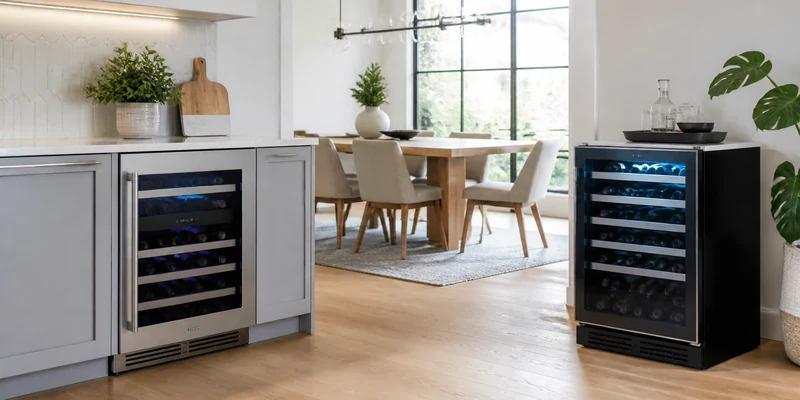
The freestanding wine fridge versus built-in question sounds like a style choice, but it is really an engineering one. The two types shed heat in opposite directions, which means each is excellent in its intended spot and actively wrong in the other’s. Buy the wrong type for your placement and no feature list will save the install.
This comparison lays out how the two designs differ, where each one wins, and the handful of checks that tell you which side of the line your home falls on. By the end, the decision usually makes itself.
Quick Answer
Freestanding or built-in wine fridge: which should you buy?
- Built-in (front-venting) if the fridge will sit inside cabinetry, under a counter, or flush against furniture. It is the only type that survives being enclosed.
- Freestanding if the fridge stands in open air with a few inches of clearance. It offers more capacity for the money and easier relocation.
- A built-in unit can stand free, but a freestanding unit can never be built in without overheating.
The Differences at a Glance
Save this table; it settles most of the debate in one pass.
| Factor | Freestanding | Built-in (front-venting) |
|---|---|---|
| Venting | Back and sides; needs open air and clearance around the body | Front grille below the door; designed to be enclosed flush |
| Placement | Open floor spots, corners, beside furniture | Under counters, inside cabinet bays, flush in furniture walls |
| Can it do the other job? | No; enclosing it causes overheating and often voids the warranty | Yes; a built-in model standing free just vents forward harmlessly |
| Price for capacity | More bottles per dollar; simpler cabinet construction | Premium for the venting engineering and trim kits |
| Look | An appliance in the room, best when styled deliberately | Disappears into cabinetry for a custom, remodeled look |
| Moving and renting | Relocates in minutes; renter-friendly | Tied to the opening it was fitted to |
| Typical widths | Varies freely with capacity | Clusters at 15 and 24 inches to match cabinet openings |
Why Venting Direction Decides Everything
Every fridge is a heat pump: it moves warmth from inside the cabinet to the air outside it. A freestanding unit dumps that warmth out the back, which works only if the back opens onto free air. Box it into a cabinet and the exhaust pools behind the unit, the compressor fights its own waste heat, cooling falters, and the machine ages on fast-forward. Manufacturers know this failure mode so well that several exclude enclosed installs from warranty coverage.
Built-in models reroute the entire airflow through a grille on the front face, under the door. Intake and exhaust share the one surface guaranteed to stay exposed, which is why the same unit can sit flush under a stone counter for a decade without complaint. The grille costs engineering and money, and that premium is exactly what you are paying for over a freestanding twin.
Where Freestanding Wins
Freestanding is the value play and the flexibility play. With no front-venting machinery to package, the same budget buys more capacity, and the whole market is open rather than the built-in subset. For renters, movers, and anyone whose bar corner migrates with the furniture, a unit that relocates in an afternoon is worth real money.
It is also the right answer when the fridge is meant to be seen. A glass-door tower beside a bar cabinet or in a dining room corner reads as intentional, especially styled with the rest of the bar; the trick is giving it the few inches of breathing room the manual asks for and keeping it out of direct sun. The main downside is aesthetic discipline: an appliance standing in a room needs a deliberate spot, or it looks parked rather than placed.
Where Built-In Wins
Built-in wins every scenario involving cabinetry. Under a kitchen counter, in a bar wall, inside a furniture bay: the front-venting design is not merely better there, it is the only safe option. The result photographs like a remodel because it effectively is one, with the fridge face sitting flush in the cabinet line and the counter above staying usable.
The costs are the premium price, the commitment to one opening, and the measuring homework: built-in success is decided by the installation sheet’s cutout dimensions, the outlet inside the bay, and the door swing against the room. Those fit rules, and the models that handle them best, are covered in our under counter wine fridge guide and the furniture-side companion on installing a wine fridge in a cabinet.
How to Decide in Three Questions
Run your situation through these in order; the answer falls out quickly.
- Will anything enclose the fridge? A counter above, cabinet sides, a furniture bay: any yes means built-in, and the conversation is over.
- Is this address permanent? Renters and frequent movers lean freestanding; owners planning a long-term kitchen or bar wall lean built-in.
- Where does the budget bite? If capacity per dollar matters most, freestanding stretches further. If the finished look is the point, the built-in premium buys exactly that.
Whichever side you land on, the wine itself wants the same things: steady temperature, darkness, and minimal vibration, all covered in our wine storage temperature guide. When you are ready to compare actual models on either side of the line, our wine fridge buying guide ranks the field.
Common Mistakes to Avoid
- Building in a freestanding unit anyway. The most expensive mistake in the category: poor cooling, early failure, and often no warranty to fall back on.
- Assuming built-in means it must be built in. Front-venting units stand free happily, which makes them the safer buy when plans are uncertain.
- Measuring the fridge instead of the cutout. Built-in installs live and die by the installation sheet’s opening dimensions, not the exterior size in the listing.
- Squeezing a freestanding unit into a tight alcove. An alcove is a cabinet with delusions. If the clearances in the manual are not there, it is an enclosure.
- Letting looks pick the type before placement does. Style follows physics here; decide the venting question first and choose finishes second.
Frequently Asked Questions
Can a built-in wine fridge be used freestanding? Yes. Front venting works anywhere, so a built-in unit standing in open air is perfectly happy. The reverse is the dangerous direction.
What happens if you enclose a freestanding wine fridge? Trapped exhaust heat forces the compressor to overwork, cooling performance drops, and lifespan shortens, often with warranty coverage excluded for enclosed installs. It fails slowly, then suddenly.
How much clearance does a freestanding wine fridge need? Whatever the manual specifies, typically a few inches at the back and sides plus some headroom. Treat those numbers as hard requirements rather than suggestions.
Are built-in wine fridges more expensive? Generally yes, for the front-venting engineering and cabinetry-matched dimensions. Freestanding models deliver more capacity per dollar when enclosure is not needed.
Which type is better for long-term wine storage? Both store wine equally well when placed correctly; storage quality comes from steady temperature, darkness, and low vibration, not from the venting direction. Placement discipline matters more than type.
The Bottom Line
Freestanding versus built-in is settled by one question: will anything enclose the fridge? If yes, only a front-venting built-in model is safe; if no, freestanding buys more capacity for less and moves when you do. Built-in units can stand free, freestanding units can never be enclosed, and the wine is equally happy either way when the placement rules are respected.